
Partners
A project made to share knowledge all over Europe
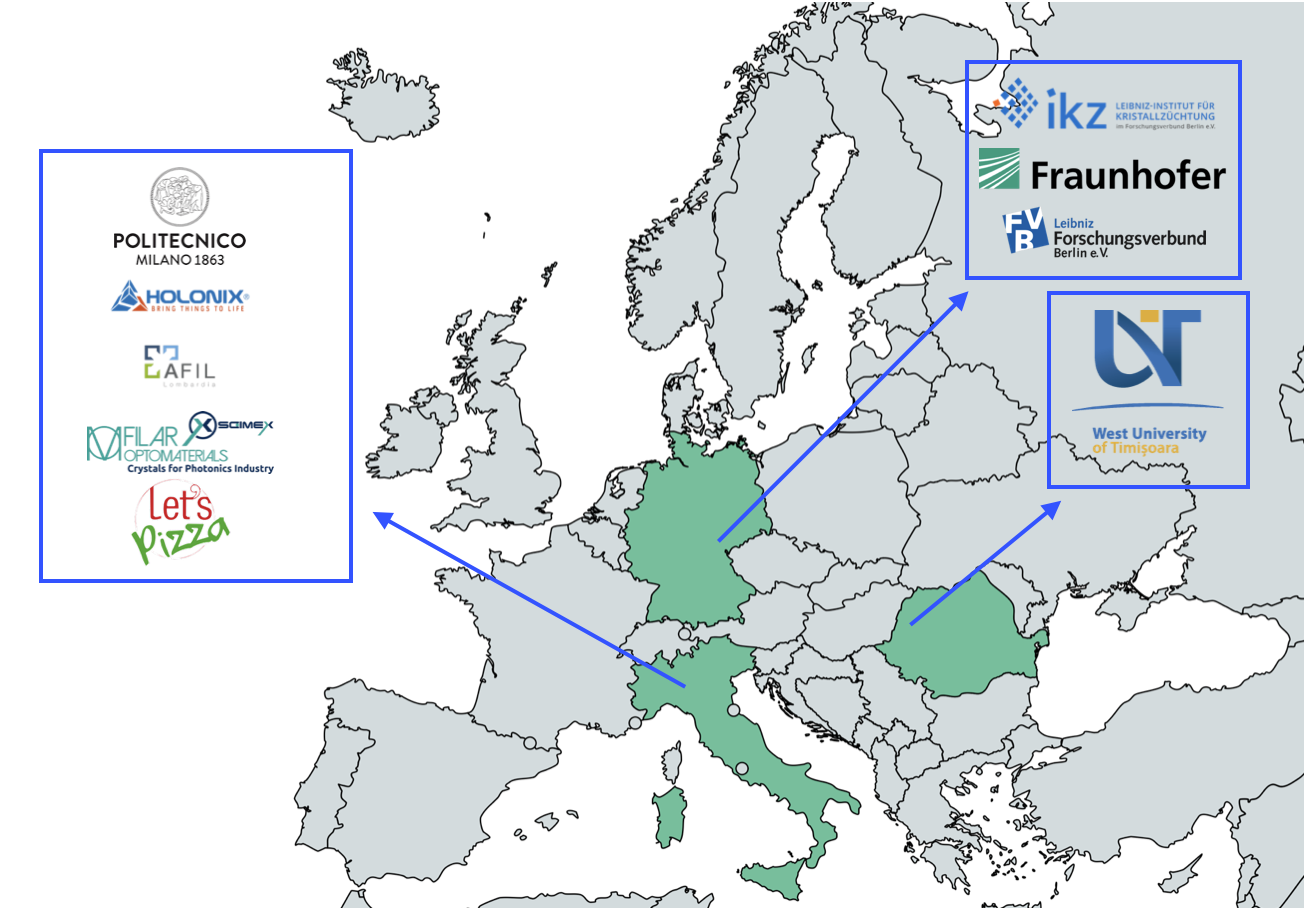
This ambitious, multi-disciplinary project is being carried out by a consortium that forms an ideal inter-regional grouping taking into consideration SMEs who receive 70% of the grant, and partners that either originate from regions that have an interest in contributing to the proposed technology or have an interest in the results. The local eco-system layers being benefitted are:
- Jena Optics Valley and Berlin – Brandenburg Optics community (Germany) from AI based manufacturing control in other types of photonics and component manufacturing and assembly.
- Lombardy industrial manufacturing community (Italy) from AI based manufacturing control of other “hot objects”.
- Bolzano information and communication centre (Italy) from multi-parametric sensor data flow and AI control for complex manufacturing equipment.
- Sardinian photonic cluster (Italy) from process sensorics and AI control for sustainable crystal growth of Alexandrites and others.
- Timisoara University crystal manufacturing and applications centre (Romania) from AI based crystal growth for other than Czochralski process.
Discover the project partners
Politecnico di Milano
Politecnico di Milano is a leading Italian technical university where 40,000 engineers, architects and designers are educated each year.
The Manufacturing and Production System Lab is part of the Mechanical Engineering Department (POLIMI-MECC).
Its main research topics concern the area of transformation processes of industrial products ranging from mechanical and technological characteristics of transformed materials to methodologies and tools for designing processes, as well as the planning, management and control of manufacturing and assembly systems.
POLIMI is ranked in the EU top 10 for Mechanical, Aeronautical & Manufacturing Engineering. POLIMI-MECC has extensive experience in the development and coordination of large innovation projects, including EU funded projects, as well as in the transfer of technological innovations to industry.
POLIMI develops AI-based Cyber-Physical Systems (CPS) control architecture that supports the integration of real-time sensor data and simulation results to enable predictive process control.
Beyond its technical contribution, POLIMI is responsible for the identification of technological synergies and value chain analysis across the manufacturing ecosystem, ensuring that the project’s results can be replicated in other “hot-object” production sectors.
Western University of Timişoara
Established in 1944 by the Royal Decree of His Majesty King Mihai I of Romania, with a history of 80 years, Western University of Timişoara (WUT) has a strong academic reputation, promoting an inclusive and integrative educational process that forms professional, complementary and entrepreneurial skills, oriented towards performance in education and research, and which attracts teachers, researchers and students from all over the world, in a multi-ethnic and multicultural environment, open and friendly.
The WUT is a comprehensive University, the largest University in the West of Romania and which, through dynamism, curricular innovation and openness to the socio-economic environment and all its partners, succeeds in being a relevant and important academic, knowledge and innovation center in Romania, with a significant impact on local, regional and national communities.
A regional leader on the educational market, with a wide range of bachelor’s, master’s and doctoral study programs, UVT offers its partners an effervescent and quality intellectual space and its students innovative student-centered educational approaches, unique study programs in Romania and an unprecedented international opening, centered around the European university alliance UNITA.
WUT supports experimental testing of AI-based control strategies and verifies improvements in yield, energy, and material efficiency; effectively integrating a digital twin of the growth process.
AFIL
AFIL – Associazione Fabbrica Intelligente Lombardia is an Italian private association, recognised by Lombardy Region as the Regional Technology Cluster for Advanced Manufacturing.
It is the outcome of a Lombardy Region-led process aiming to set up a network of Clusters interested in carrying out, at national and at international level, an integrated and sustainable system of infrastructures, competences and methodologies supporting research and innovation.
In particular, AFIL represents a network of companies, universities, public or private research institutions and entities active in the field of Advanced Manufacturing.
The mission of AFIL can be summarized as follows:
- setting up a stable community by connecting all the different stakeholders and favouring cooperation by promoting R&I projects and initiatives;
- being a reference actor for Lombardy Region for the definition of Research and Innovation policies in the manufacturing sector, with reference to Smart Specialisation Strategy (S3);
- supporting the development of R&I interregional networks through the participation to National Intelligent Factory Cluster (CFI) and the connection with different European regions within Vanguard Initiative, European Cluster Collaboration Platform, Four Motors of Europe and Smart Specialisation Platform.
AFIL participates to the dissemination, exploitation, and policy linkage activities, connecting SMART-Growth with regional and European innovation ecosystems.
It represents the Lombardy advanced manufacturing cluster, facilitating cross-sector cooperation and promoting industrial adoption.
Fraunhofer Institute for Applied Optics and Precision Engineering
The Fraunhofer Institute for Applied Optics and Precision Engineering (IOF) develops solutions for all aspects of generation, guidance, and measurement of light and photons.
For all applications of light, the institute offers the entire value chain, and specialized, individual process steps for each of these areas the design, the production of components, the assembly to opto-mechanical or opto-electronic systems, as well as a holistic characterization.
The interdisciplinary focus of the institute’s competences in the fields of optics and precision engineering allows to develop complex and unique photonic components and systems.
Within the “Opto-mechatronical Components and Systems” department such photonics systems are integrated for harsh industrial environments, and multi-parametric functionality.
Fraunhofer IOF coordinates the SMART-Growth project and leads the development of multi-parametric process sensorics for crystal growth and other “hot object” processes.
Beyond the technical contribution and coordination, F-IOF is also responsible for the exploitation and business sustainability of the developed innovations.
IKZ
The Leibniz Institute for Crystal Growth (IKZ) in Berlin-Adlershof stands as a distinguished international hub for advancements in crystalline materials, spanning the realms of science, technology, and innovation.
With a spectrum of research endeavors spanning from fundamental to applied pre-industrial and industrial level investigations, the institute is at the forefront of addressing societal challenges in realms such as artificial intelligence, energy, and health.
IKZ distinguishes itself through its prowess in crafting high-quality crystalline materials, specializing in semiconductors, oxides, and fluorides, each tailored to specific properties. This proficiency stems from the institute’s expertise in plant engineering, numerical simulation, and crystal growth.
Notably, IKZ’s emphasis on volume crystals, nanostructures, and thin films sets it apart within the field. For instance, the institute delves into the growth of monocrystalline silicon using the Czochralski method and gallium arsenide via vertical gradient freeze techniques, exploring their application in renewable energy through photovoltaics.
Additionally, IKZ actively engages in the burgeoning realm of efficient power conversion, optimizing established materials like float-zone silicon while pioneering newcomers such as gallium oxide and aluminum nitride.
IKZ advances physics-based Computational Fluid Dynamics (CFD) models for crystal growth processes, calibrated through experimental data from the pilot furnaces. IKZ shall provide the physics-based model tailored to the industrial demonstrator and AI model for replication.
Filar Optomaterials
Know as Scimex that was founded in 1997 and based in Tortolì (Italy), FILAR OptoMaterials (FOM) is a company specialized in production of crystals for photonic applications.
Its expertise spans from solid-state laser components to ophthalmic optics. It has an industrial facility area of 15000 sqm with two main buildings with 2000 sqm, can provide customized solutions according to clients demand.
Equipped with seven growth stations capable of reaching temperatures up to 2400°C, along with four vacuum coating machines, including three with diameters exceeding 700mm and one with a diameter of 300mm.
Additionally, it hosts a quality control lab equipped with advanced instruments such as interferometers, spectrophotometers, lasers, radiometers, and a radioactive source.
FILAR OptoMaterials hosts the industrial pilot demonstrator in Sardinia, where the project’s AI-based control system and sensorics technologies are validated under real manufacturing conditions.
Holonix
Holonix, founded in 2010 as a spin-off from Politecnico di Milano, is an autonomous company specializing in advanced ICT solutions for the manufacturing sector.
It focuses on Lifecycle Data and Knowledge Management, with its key product being the “i-LiKe” platform, which aggregates data from smart products and production environments to support all phases of the product lifecycle.
Holonix’s team, mainly from consultancy backgrounds, ensures strong links to research through senior Ph.D. researchers.
The company is active in standardization efforts and is a member of The Open Group’s IoT Group. Its offerings include the “i-Like” suite and “i-Like Machines,” both derived from research projects, and it also provides consultancy for adopting IoT and Open Innovation paradigms.
Holonix participates in European projects and is now focusing on the circular economy to create new value chains and eliminate information silos.
Holonix designs a hw/sw architecture that delivers trustworthy time-based process data to AI-based CPS controller while preserving the integrity of legacy PID controller and shopfloor operations, and develops a middleware stack composed by sw components for data ingestion, storage, and visualization.
Beyond the technical contribution, Holonix participates to exploitation and dissemination activities, promoting the collaboration with the community hub AI4manufacturing.
Parco Genetico dell’Ogliastra
The Ogliastra Genetic Park Society is a limited liability consortium company that does not pursue profit-making activities and has the purpose of carrying out basic scientific and technological research and applied to production processes with socio-economic repercussions in Ogliastra.
The Genos Park was created in 2000 with the role of locally coordinating the activities of national and international scientific institutes, local authorities and public and private institutions, in the field of research on human, plant and zootechnological biology, with particular reference to biotechnology, to molecular genetics, biomedicine, bioinformatics and biopharmaceuticals.
Among the aims of the Genos Park is that of defining the genes responsible for multifactorial genetic diseases through a statistical, anthropological and genetic survey carried out through a screening of part of the Ogliastra population.
The Perdasdefogu laboratory carries out activities of collection, preparation and storage of biological samples, immortalization of cell lines and chemical-clinical analysis of haematological samples, biobank management, assistance and organization of specialist medical examinations. In particular, he has been collaborating since 2001 with the Institute of Population Genetics of the CNR of Sassari and the Shardna Spa company for the study of multifactorial diseases in the genetic isolates of Ogliastra.
Parco Genetico is the co-coordinator for project management. Its role is to facilitate local cooperation and infrastructure hosting in Sardinia, while supporting experimental setups at FILAR and fostering connections with regional research and innovation networks.
Cibolabs
Located in Bolzano, business involved a huge number of stakeholders across a wide number of sectors – from Pizza machines’ parts manufacturers to, logistics companies, quality assurance operators, Artificial Intelligence development, all of them actually contribute to the evolution of this Italian SME.
CiboLabs develops the control-loop hardware and contributes to the integration of Cyber-Physical Systems (CPS) for predictive control.
Its technology visualizes sensorics and CPS outputs into actionable commands to enable real-time decision making.